ICN Data Club
Dimensional Analysis: A Potential Use of Dimensionless Products in Biology/Neuroscience
Presented by Lungsi, 26 July 2021
The Problem
Consider the research by Ke et al. (2020)
Ke, H.-Y., Yang, H.-Y., Francis, A. J., Collins, T. P., Surendran, H., Alvarez-Laviada, A., Firth, J. M., & MacLeod, K. T. (2020). Changes in cellular Ca2+ and Na+ regulation during the progression towards heart failure in the guinea pig. The Journal of Physiology, 598(7), 1339–1359. https://doi.org/10.1113/JP277038
Normal Pysiology: Action potential in T-tubules triggers Ca2+ cascade
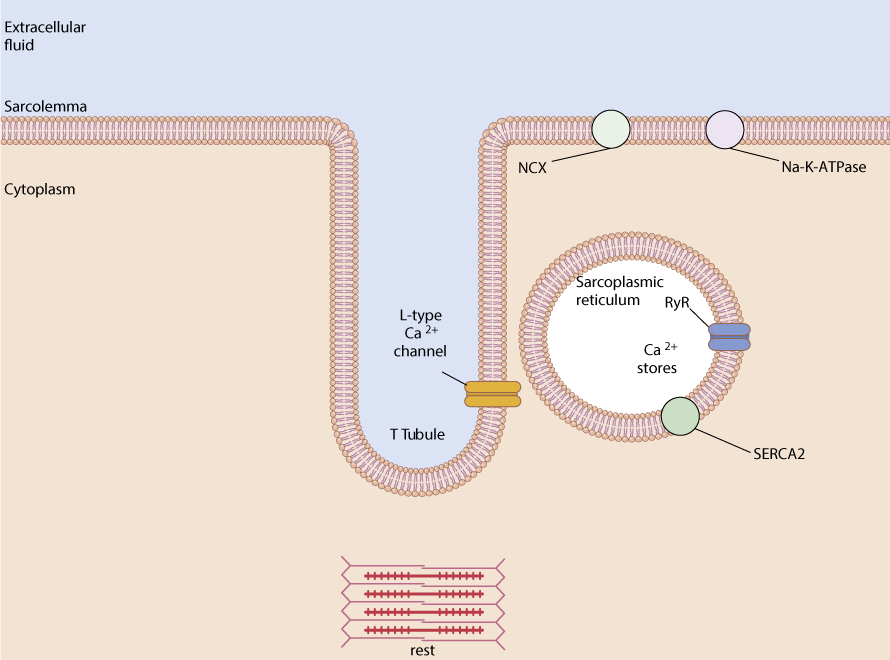
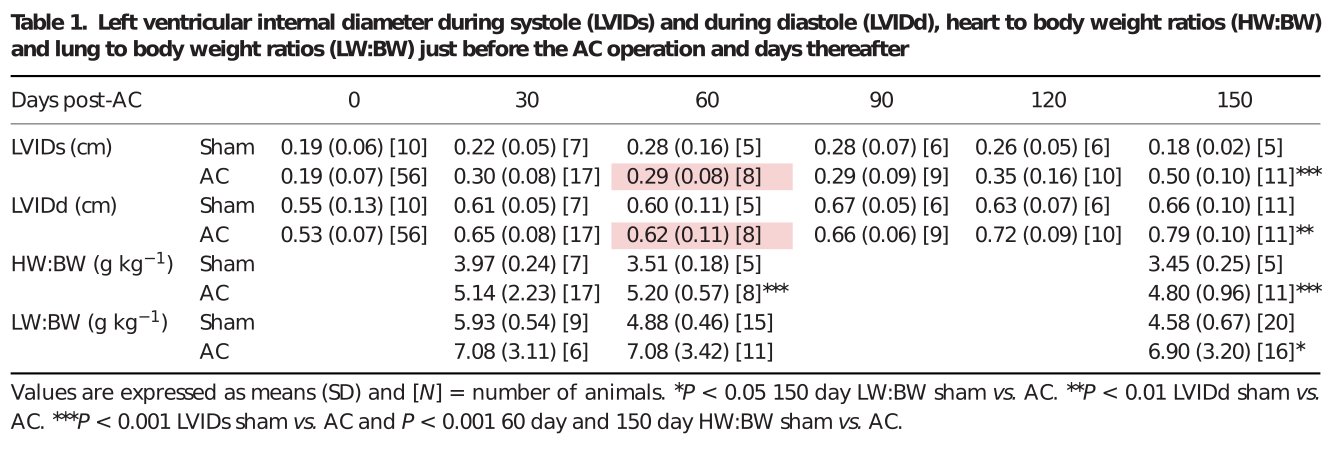
Left ventricle hypertrophy: As hypertrophy progresses what does the kinetic of cytoplasmic Ca2+ look like?
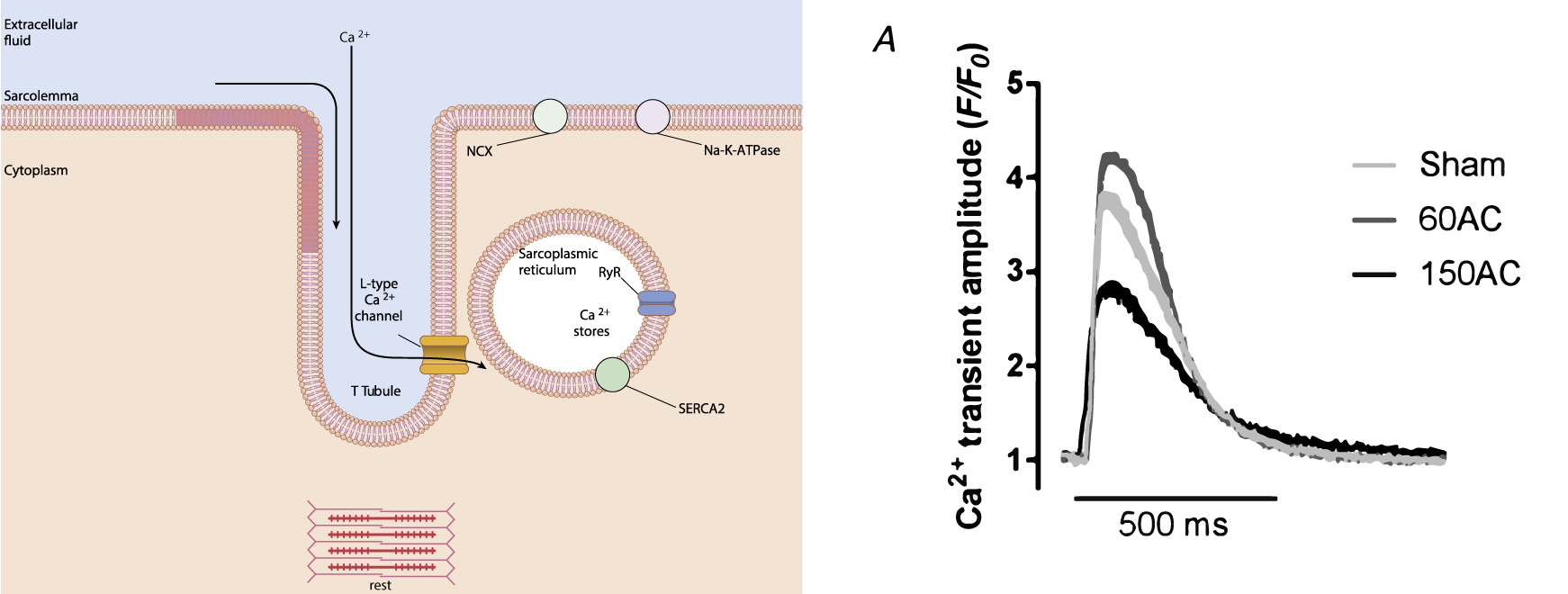
Compared to control the amplitude of Ca2+ at compensated stage is larger. But, as the hypertrophy progresses the amplitude decreases significantly. Decrease in amplitude indicates slow removal of cytosol Ca2+.
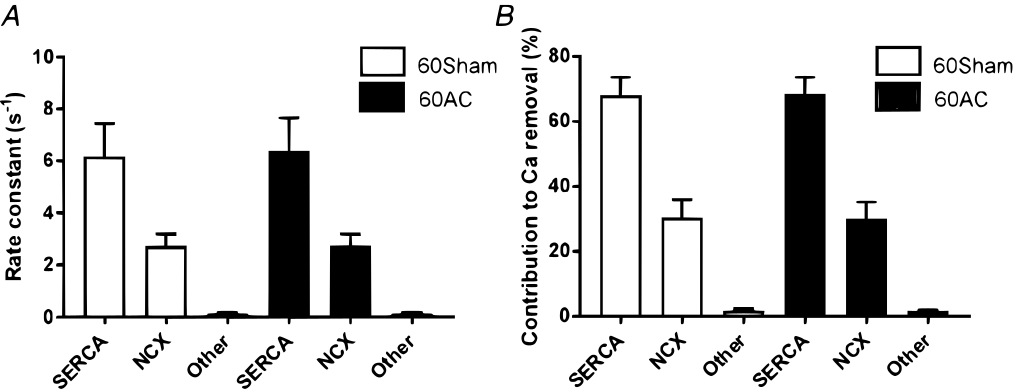
Are any transporter responsible for the slow removal of cytosol Ca2+?
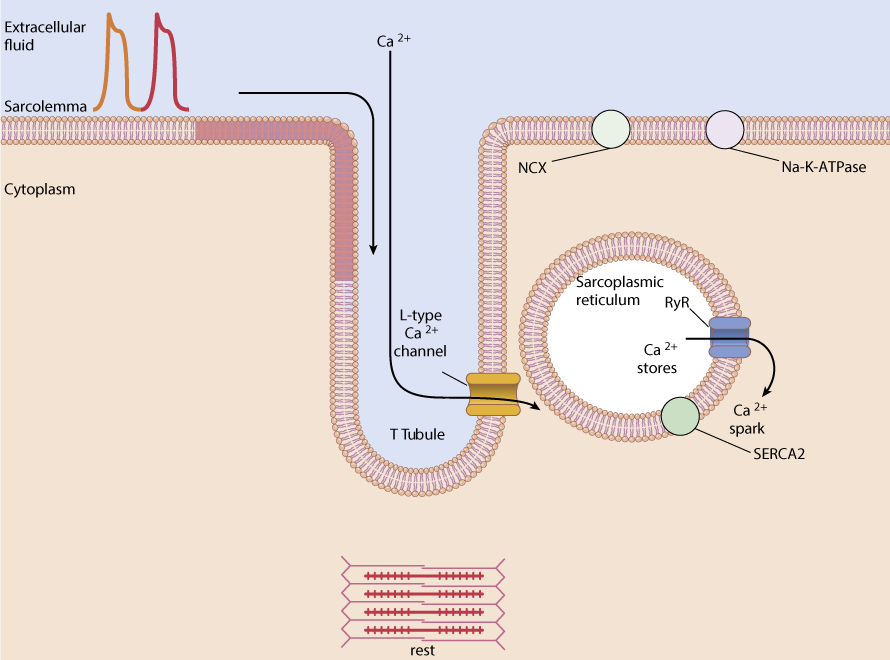
What about Ca2+ sparks?
What could explain the results seen during compensated stage of hypertrophy?
What is the pump activity after reactivation?
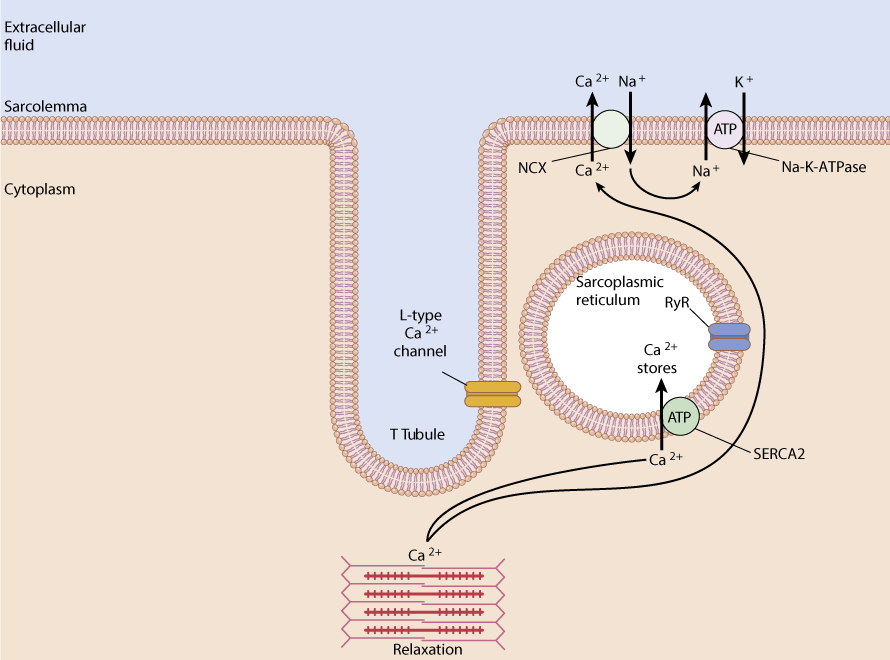
What could explain for the decreased Na-K-ATPase current and the decreased Na+ outflow?
Is the amount of pump protein decreased during hypertrophy?

Could the 50% reduction in pump current during compensated stage be a mechanism for preserving contractility function?
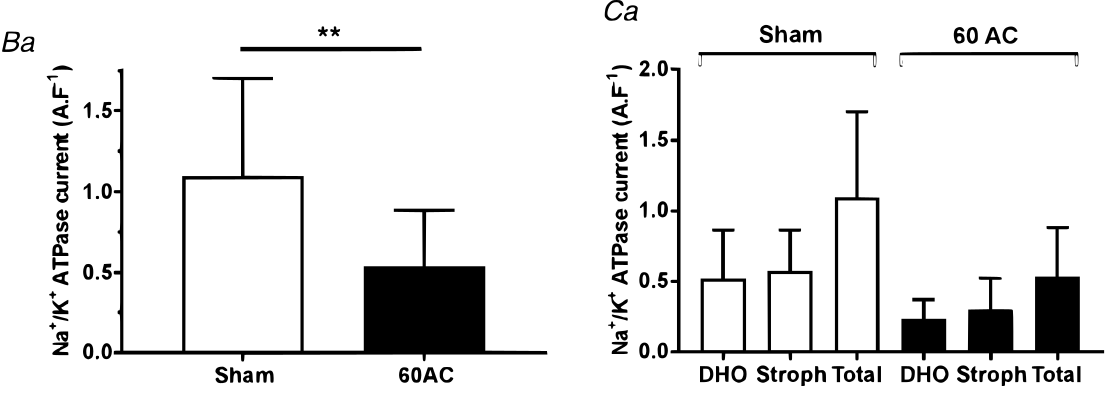
Hypothesis: During compensated stage the inhibition of Na-K-ATPase current increases SR load (Ca2+ SR store) and consequently maintains Ca2+ transient.
What technique or tool can we use to put together these myriad of experimental observations into a consistent (hopefully more comprehensible) system?
Dimensional Analysis
What is a dimension?
It is simply a tag we attach to a quantity in an equation expressing some physical law... [D]imensions are only symbols of an elementary algebra, involving neither addition nor subtraction. To ask what are the true or natural dimensions of a quantity makes no more sense than to ask what is the true or natural word for goldfish. (McNish, 1957)
Why are there seven base dimensions?
[F]or the simplest mechanical quantities we need four dimensions to avoid ambiguities, five, if we include solid angle; that if we set one of these quantities equal to unity we can get along with four. But having one quantity equal to unity we cannot set another equal to unity without creating an ambiguity. Thus, unity itself becomes like a dimension, so again we may say we have five. Heat and electromagnetism add at least two more required dimensions. So I might venture to say that we should have seven elemental dimensions, at least, but I do not know, because I do not comprehend all of physics. One, of course, may get along with fewer dimensions if he will tolerate some ambiguities. (McNish, 1957)
Can we also reduce all units to a few "absolute" units?
The symbols for the dimensions follow the rules of algebra but units are not bound by algebraic rules. Therefore, provided that the parent equation is not violated one may set as may quantities equal to 1 thus reducing it to a few "absolute" units. However, this is not recommended. Because,
- measuring many units require difficult experiments
- measurement must by accurate
The magnitudes of quantities are not determined by nature, but by the units we have arbitrarily chosen for our measurement system.(McNish, 1957)
What is dimensional analysis?
Dimensional analysis is purely algebraic whose theory is the mathematical theory of dimensionally homogeneous functions, a special class of general types of mathematical functions.
What is a dimensionless product?
If x meters, y seconds and z kilometers are quantities with dimensions, i.e. dimensional quantities, then x meters ⋅ y seconds is a dimensional product. However, x meters ÷ z kilometers is a dimensionless products.
Therefore, a dimensionless product is more than just a scalar it still carries the dimensional information of various quantities it is a product of.
Why study dimensionless products?
Can provide complete information in a compact form.
Example: Drag of a body immersed in stream of incompressible fluid
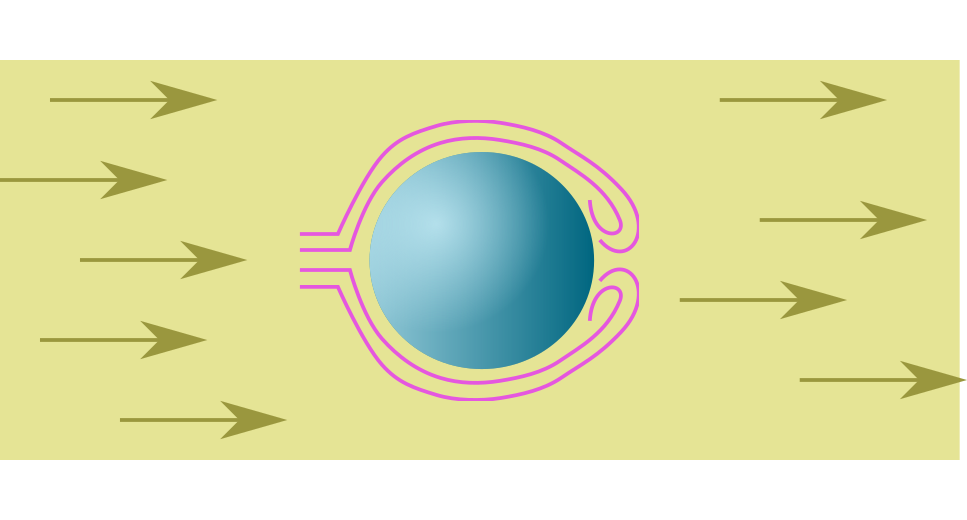
Dimensional analysis to transform the hypothetical expression.
F = f(V, D, ρ, μ) can be transformed intoF ÷ (ρV^2D^2) = f1( (VDρ) ÷ μ ).
Notice,
- the equation is dimensionally homogeneous
- left hand side and right hand side are both dimensionless
- f1 is an unknown function
- the four variables are compounded into a single independent variable of f1
Substituting for some parameters and constants ((VDρ) ÷ μ → (VD) ÷ (μ ÷ ρ) ÷ R, Reynolds number) this can be reduced for a spherical body with area (1/4)πD^2 to
F = (1/2)CρV^2Awhere C = (8/π)f1(R), the drag coefficient.
Experimental graph from the derived relationship
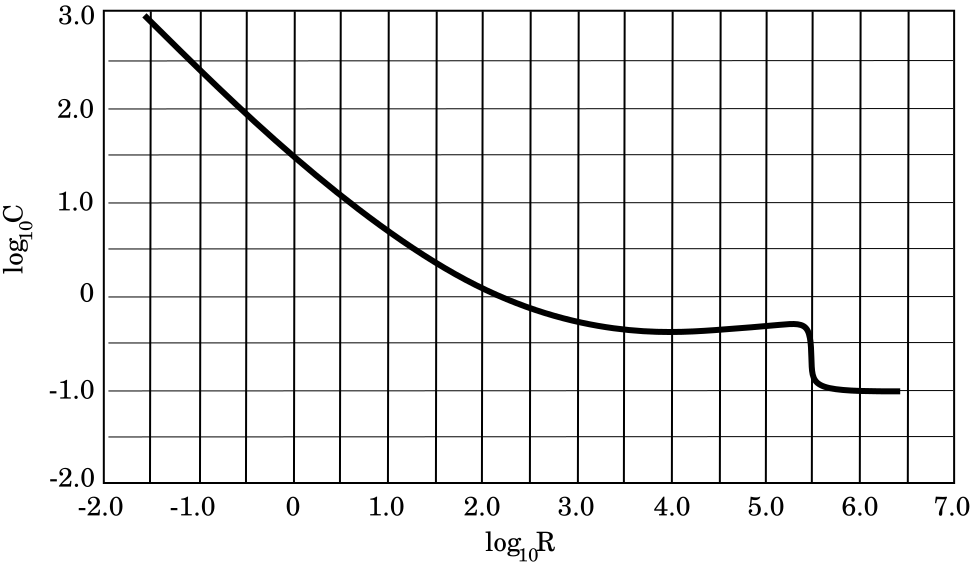
This graphs contains information for
- drag forces on smooth spherical bodies of
- all sizes
- in an incompressible fluid with
- any density,
- any viscosity and
- any speed of flow
Two important properties of dimensionless graphs
- can provide much more information than graphs having dimensions
- points in the graph can be determined experimentally.
Minimum prerequisite on
the theory of dimensionless products
General algebraic formula for transforming units

This is the general formula for a system based on the seven fundamental dimensions: [M], [L], [T], [A], [K], [cd] and [mol]. Here, W^w is such that original unit = W ⋅ new unit.
Mathematical definition for
dimensional homogeneity

Definition of dimensionless product
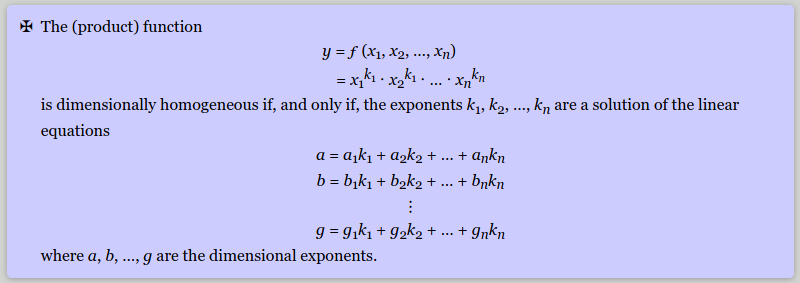
If the product y has no dimension it is called a dimensionless product.
Notion of K-space
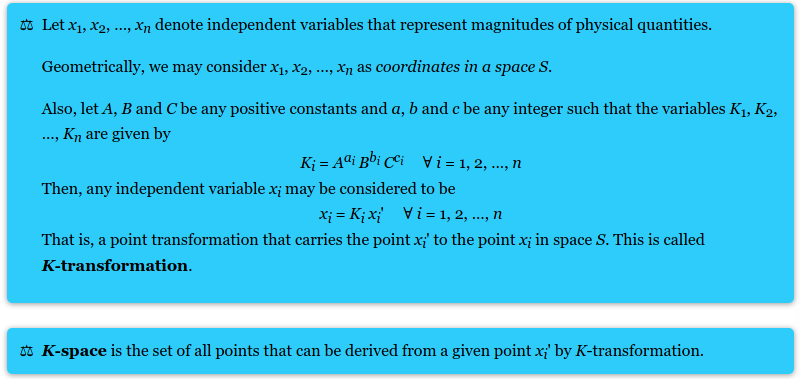
This idea of K-space is essential to reducing non-dimensionless products to dimensionless product.
Buckingham's theorem

This theorem is at the heart of calculating the complete set of dimensionless products.
Theorem for number of elements in a complete set of dimensionless products

Systematic calculation for dimensionless products
The four step approach
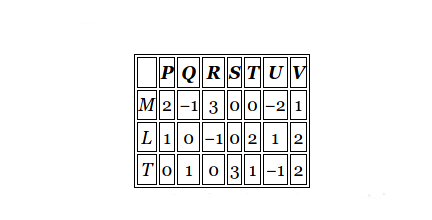
Consider the problem f(P, Q, R, S, T, U, V) in a MLT-dimensional system such that the
relationship of the independent variables with respect to the three base dimensions can be placed in a table. This is the dimensional matrix (Step-1).
Definition for dimensionless products tell us that it is of the form

To solve this we
set one k on the right side of the equation to unity and the rest to zero until we exaust all the k's of the right side. Representing this in
tabular form we notice that submatrix is an identity matrix. This is the
solution matrix (Step-3) where each matrix entry represents the exponents of quantities for
respective dimensionless product (Step-4).
Softwares that deal with dimensions
in some shape or form
diman
diman© is my in-house Clojure based software for dimensional analysis. By default it is based on a seven dimensional system built on the seven base dimensions: [M], [L], [T], [K], [A], [mol] and [cd] representing the quantities mass, length, time, thermodynamic temperature, electric current, amount of substance and luminous instensity respectively.
diman© is capable of performing dimensional consistency checks and derive dimensionless products. The program aims at simplifying the tedious computational steps particularly while deriving dimensionless products.
Getting dimensionless products using diman©
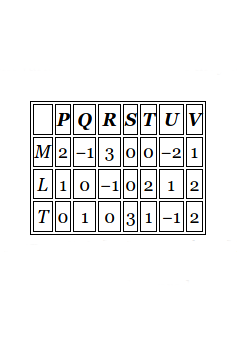
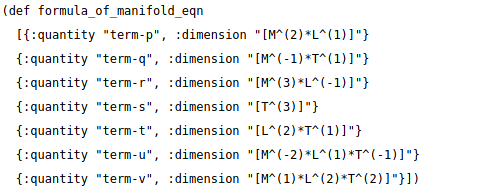
standard_formula and
defining the independent variables in terms of their dimensional formula. Without the last step the dimensional formula for respective independent variable cannot be obtained for deriving the dimensionless products.Now the user can compound the processes for generating the dimensional matrix, solving the homogeneous equation and determining the solution matrix in a single code block. Notice that we get the same solution matrix and therefore the same set of dimensionless products.
What is complete set of dimensionless products for Ca2+ transient in cardiac hypertrophy?
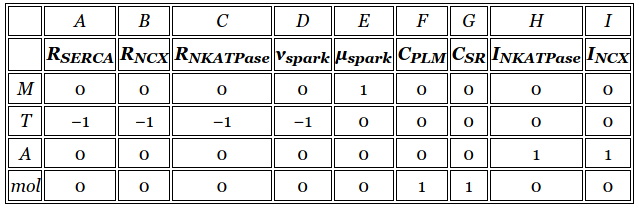
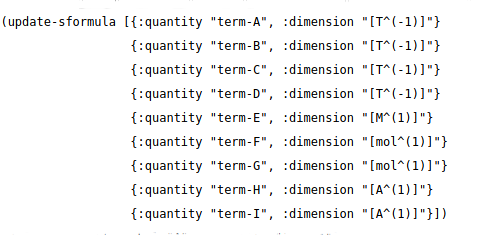
A few rules of thumb on deciding the dimensional independent variables
- it must affect the phenomenon that is being studied
- ommitting variables that logically influence the phenomenon can lead to impasse in calculation or worse, erroneous result
- things that are practically constants can be considered a variable
- understand the problem well enough to explain why and how the variable influences
- have a theory (even if it is crude) of the mechanism of the phenomenon
The success of any physical investigation depends on the judicious selection of what is to be observed as of primary importance, combined with a voluntary abstraction of the mind from those features which, however attractive they may appear, we are not yet sufficiently advanced in science to investigate with profit. - J. Clerk Maxwell
Bibliography
-
BIPM (2020). Base unit definitions. Retrieved from https://www.bipm.org/en/measurement-units/base-units.html
-
Buckingham, E. (1914). On Physically Similar Systems; Illustrations of the Use of Dimensional Equations. Phys. Rev., 4(4), 345–376. https://doi.org/10.1103/PhysRev.4.345
This is the original paper for Buckingham's Theorem.
-
Langhaar, H. L. (1951). Dimensional Analysis and Theory of Models. John Wiley & Sons, Inc.
Comment: A practically comprehensive book on dimensional analysis.
-
McNish, A. G. (1957, April 1). Dimensions units and standards. Physics Today, 10(4), 19. https://doi.org/10.1063/1.3060330
This is an excellent talk at the National Bureau of Standards, 1956.
-
Ngwua, L. (2021, July 4). Theory of Dimensionless Products. NeuralGraphs.
McNish, A. G. (1957, April 1). Dimensions units and standards. Physics Today, 10(4), 19. https://www.neuralgraphs.com/lectures/diman/lectp8.html
My comprehensive lectures on the theory of dimensionless products.
-
Preussner, G. M. (2018, May 24). Dimensional Analysis in Programming Languages. Personal Homepage. https://gmpreussner.com/research/dimensional-analysis-in-programming-languages
The software survey is based on this work.